UX Research
Overview
Techo is a Latin American nonprofit that works alongside young volunteers and families living in informal settlements to overcome poverty — building housing, forming community, and developing active citizenship in equal measure.
As part of my Postgraduate Diploma in UX Research at Universidad de Belgrano, our team was commissioned by Techo Europa to conduct a real research engagement. The client's goal was concrete: double the number of international volunteers participating in their program, and improve the experience of their website — the primary entry point for prospective volunteers based in Europe.
This was not a classroom exercise. We worked directly with Techo's stakeholders, used their data, and delivered findings to their team.

My role
I was part of a five-person research team, each coming from different professional backgrounds. We had no formal role assignments — we collaborated as peers throughout, dividing individual research tasks and coming together for group sessions.
The problem
Techo Europa had a clear business goal — grow its international volunteer base — but lacked insight into why prospective volunteers weren't converting. The research question wasn't simply "what's wrong with the website." It was broader: who is the international volunteer, what motivates them, what gets in their way, and where does the experience break down — from first discovery all the way to after the trip ends.
The challenge was that the volunteer journey spanned multiple touchpoints and stages: learning about the program, deciding to apply, going through the experience, and returning home. Understanding that full arc — not just the website — was the only way to give Techo direction it could actually act on.
Methodology
We structured the research in two phases. First, each team member conducted independent discovery work to build a shared foundation — understanding Techo, its users, and the competitive landscape before coming together with stakeholders. Then, as a group, we moved into direct contact: a stakeholder workshop, a heuristic evaluation of the website, usability tests, and in-depth interviews.
The combination of individual and collaborative methods meant we arrived at every group session already grounded. That made the analysis richer and the synthesis faster.
Research
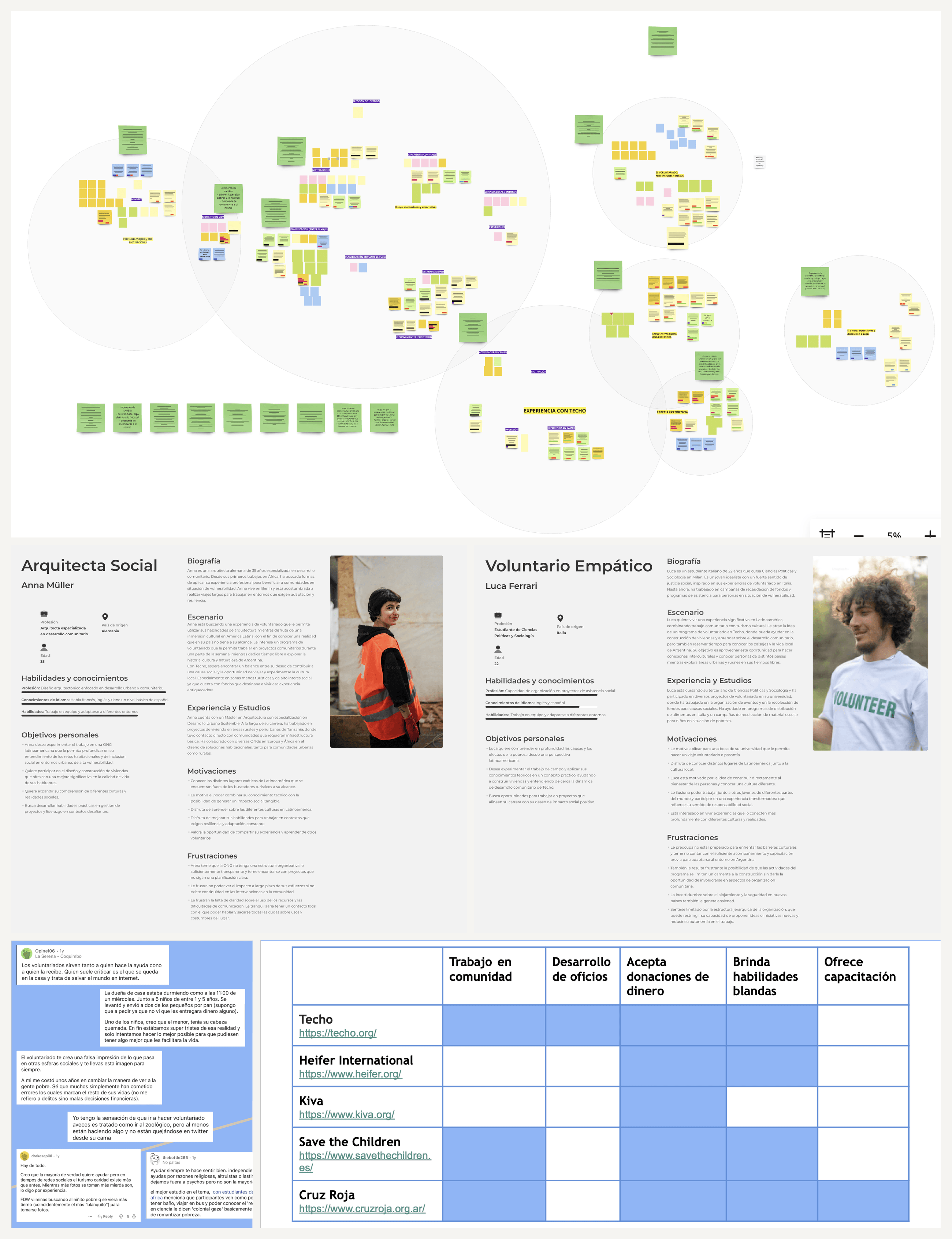
My individual discovery work covered three fronts.
Mapping Techo's organizational logic through the 5 Whys revealed the dual purpose at the heart of its volunteer program: building housing while forming young people as active citizens. That distinction — between construction as output and civic formation as intent — would matter later when thinking about how the program communicated its value to prospective volunteers.
The competitive analysis compared Techo against four similar organizations. It stood out for offering hands-on community work and real skill development, but lacked structured training — something only one of the organizations analyzed provided. That gap pointed to an opportunity: what Techo already did well, combined with more deliberate preparation, could significantly strengthen its value proposition for international volunteers.
Secondary research through social listening added a less comfortable layer. Online, Techo's reputation was mixed: volunteers described the experience as meaningful, but recurring critiques around resource management, housing quality and the optics of voluntourism — the perception that participants were seeking an experience more than contributing to a cause — surfaced consistently. That tension between genuine impact and performative volunteering became a thread that ran through the rest of the research.
The stakeholder workshop brought the team together with Techo Europa's leadership to align on objectives and analyze the project brief. The session confirmed the target user: young Europeans aged 20 to 28, with or without prior volunteering experience, whose first point of contact with the program was the website. It also surfaced a question we hadn't fully anticipated — the site needed to work for multiple types of volunteering, from short building trips to longer international experiences, and Techo hadn't yet defined a clear journey for any of them.
Heuristic evaluation
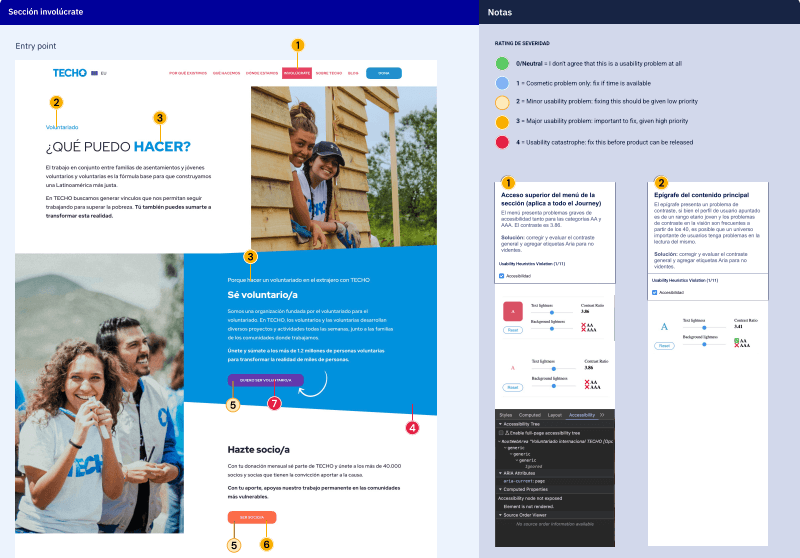
With the discovery phase complete, the team evaluated the website itself — mapping the full path a prospective volunteer would take, from the homepage through to submitting a registration form, and assessing each stage against Nielsen Norman Group's severity scale.
The most critical failures concentrated in two areas. On the landing page, the opening section raised questions the copy never answered: what can I do here, and why volunteer abroad with Techo? Information was disorganized, terminology shifted without explanation, and the page offered no clear entry point for someone arriving with genuine curiosity but no prior knowledge of the organization.
The registration form compounded this. The dropdown of volunteering options appeared without context — users were asked to choose between programs that had never been introduced. Interaction conventions were violated, there was no way to review or edit before submitting, error states were entirely absent, and the confirmation screen gave no reliable signal that the application had gone through.
Accessibility issues ran throughout: contrast ratios failed WCAG AA standards, interactive elements lacked ARIA labels, and images had no alt text.
What the evaluation revealed wasn't a set of isolated problems — it was the absence of a content strategy and a defined user journey. The site had been built without a clear picture of who it was for or what it needed them to do. That picture was what the next phase set out to build.
Usability testing
Following the heuristic evaluation, we recruited five participants based in Europe — all professionals with an interest in social or community action and a desire to travel — and ran moderated remote sessions, structured around four stages: finding Techo through search, navigating the "Get Involved" landing page, completing the registration form, and reflecting on what came next.
The first finding arrived before users reached the site. In every session, Techo Europa failed to appear in search results — across geographic, activity-based, and autocomplete-prompted terms. At the exact moment these users were actively looking, Techo was invisible.
On the landing page, the structural problems the heuristic had flagged became visible in real time. Participants couldn't distinguish between the different volunteering options and arrived expecting information the page didn't provide: destination, duration, accommodation, safety conditions. One detail triggered drop-off across multiple sessions — a reference to an age restriction that several participants read as a blanket limitation on all volunteering, and said they would have left the site at that point.
The registration form opened in a separate tab with a visual design that didn't match the rest of the site, generating distrust before users had read a single field. Inside, they encountered terminology most couldn't interpret, questions that created confusion, no way to review or correct their responses, and no clear confirmation that the form had been received. There were no questions about the participant's background or interests, which struck several users as contradictory given the landing page's emphasis on personal fit. Three of five participants finished the session uncertain whether their application had actually gone through.
What usability testing added beyond the heuristic was the emotional register of the experience — the specific moments where interest became hesitation, and hesitation became abandonment.
User interviews
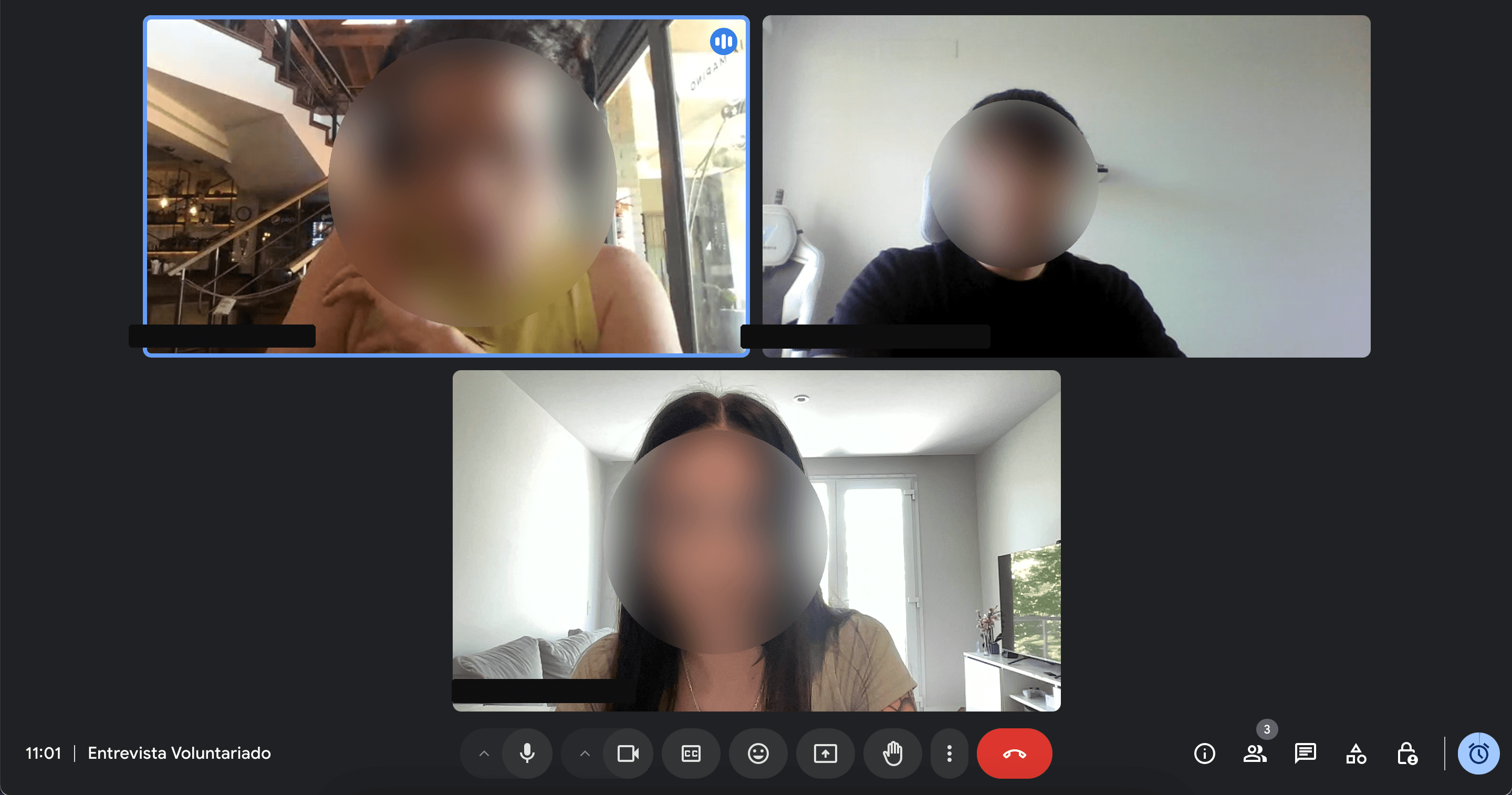
To understand the volunteer beyond their interaction with the website, we conducted in-depth interviews with people who had prior experience with international volunteering or a strong interest in it. The goal was generative: not to evaluate Techo specifically, but to understand what motivated people to do this at all, and what made the difference between an experience they remembered and one they walked away from.
Several patterns emerged consistently. The decision to volunteer internationally wasn't reducible to altruism. Participants described motivations they didn't see as contradictory: contributing meaningfully while also traveling, encountering unfamiliar contexts, and coming back changed. People who had done it before talked mostly about what it had given them — perspective, community, a shift in how they understood the world.
The pre-trip period was the most anxiety-laden phase. Before committing, people needed to know what they'd be doing, who they'd be with, whether the organization was legitimate, and whether support would be available if something went wrong. The absence of that information was the primary reason participants described walking away from experiences they had initially wanted to pursue. Transparency wasn't something they appreciated. It was the precondition for trust.
That relationship with the organization didn't end at registration. Participants expected ongoing contact — orientation before departure, emotional preparation for the field, and follow-up afterward. Several described frustration with organizations that went quiet after accepting an application, or that left volunteers to process the realities of fieldwork on their own. Arriving unprepared — practically, culturally, emotionally — surfaced repeatedly as a point of failure.
On cost, participants were pragmatic: willing to contribute, but only if the value felt proportionate and the financial requirement was communicated honestly and early. Discovering a cost mid-registration — with no prior indication — was enough to break the process entirely.
Techo itself generated mixed responses. The brand carried recognition and general trust, and the construction model was seen as concrete in a way many NGO programs aren't. But participants who had interacted with it directly described a gap between the promise and the experience: poor communication after registration, insufficient preparation before fieldwork, and little sense of continuity after the trip ended.
Across every conversation, one thing was consistent. People weren't afraid of what the experience might be like. They were afraid of going in without knowing.
Outcomes
The research concluded with a formal presentation to Techo Europa's stakeholders, delivering findings across four axes: value proposition and transparency, website communication, community and volunteer retention, and cost and voluntourism. Each axis translated directly into actionable recommendations grounded in what participants had actually said and experienced.
There were no measurable post-delivery outcomes to report — the engagement ended at the handoff stage, which is common in commissioned academic research. What the project did produce was a clear, evidence-based picture of where the experience was breaking down and what it would take to fix it: not isolated UX patches, but a more fundamental rethinking of how Techo communicates, accompanies, and retains its international volunteers.
Reflections
One of the most instructive tensions in this project was the gap between what the client wanted to solve and what the research actually surfaced. Techo Europa came in with a concrete business goal — double the number of international volunteers — and an assumption that the website was the primary obstacle. What we found was that the problem ran deeper: invisibility in search, a registration experience that generated distrust, insufficient preparation before the trip, and no meaningful continuity afterward. The website was a symptom, not the cause.
What this project also made visible for me was the difference between research as an isolated engagement and research as part of a live product cycle. For a year, we investigated while the experience remained unchanged — users were dropping off in real time, and the findings we were building toward had no parallel track moving to address them. That's not a critique of the project itself; it's simply what a pure research commission looks like. But coming from a design practice where research and iteration happen in close proximity, the distance felt significant.
It reinforced something I already believed but hadn't experienced so directly: the most valuable research is the kind that feeds immediately into decisions. Not because research without implementation is worthless — it isn't — but because the gap between insight and action is where momentum is lost.